16 Children Removed From "Deplorable" Ohio Home in Vinton County: What We Know So Far
Ohio authorities have removed 16 children, ranging in age from 18 months to 18 years, from a home in the village of Hamden after investigators described conditions inside as "horrific" and "almost indescribable." Four adults sharing the Siders surname were arrested and face second-degree felony child endangering charges. Two children were flown to Level 1 trauma centers. Here is what has been reported so far, what the charges mean, and how communities can respond when children are living in silence next door.
 What Happened in Hamden
On the morning of Tuesday, June 30, 2026, agents with the Ohio Bureau of Criminal Investigation (BCI) and deputies from the Vinton County Sheriff's Office executed a search warrant at a home on Ohmer Street in Hamden, a village of roughly 200 residents in rural Vinton County, about 60 to 80 miles southeast of Columbus. According to reporting from The Associated Press and USA Today, the warrant was part of an investigation that had been unfolding "for some time" before officers moved in.
Inside, investigators found 16 children, all members of the same family according to officials, living in conditions the state's top law enforcement officer called almost beyond words. Ohio interim Attorney General Andy Wilson told reporters the children appeared to have spent most of their time in a single room for much of the four years the family lived at the address. Wilson described what officers walked into as "almost indescribable" and said the home "really looked third world." Vinton County Sheriff Ryan Cain said simply, "The scene is horrific, and these are horrific allegations."
The condition of the children reflected what officers found. Some could not speak or give their names when responders reached them, and their medical status was so fragile that transport to a hospital (not questioning, not statements) was the immediate priority. Seven children were taken to hospitals in Columbus for treatment, and two of the most seriously injured were flown by medical helicopter to Level 1 trauma centers, the highest tier of trauma care available in the region. Officials stressed that this was not a human trafficking case; the children, both boys and girls, are all part of the same extended family unit.
The Four Adults Charged
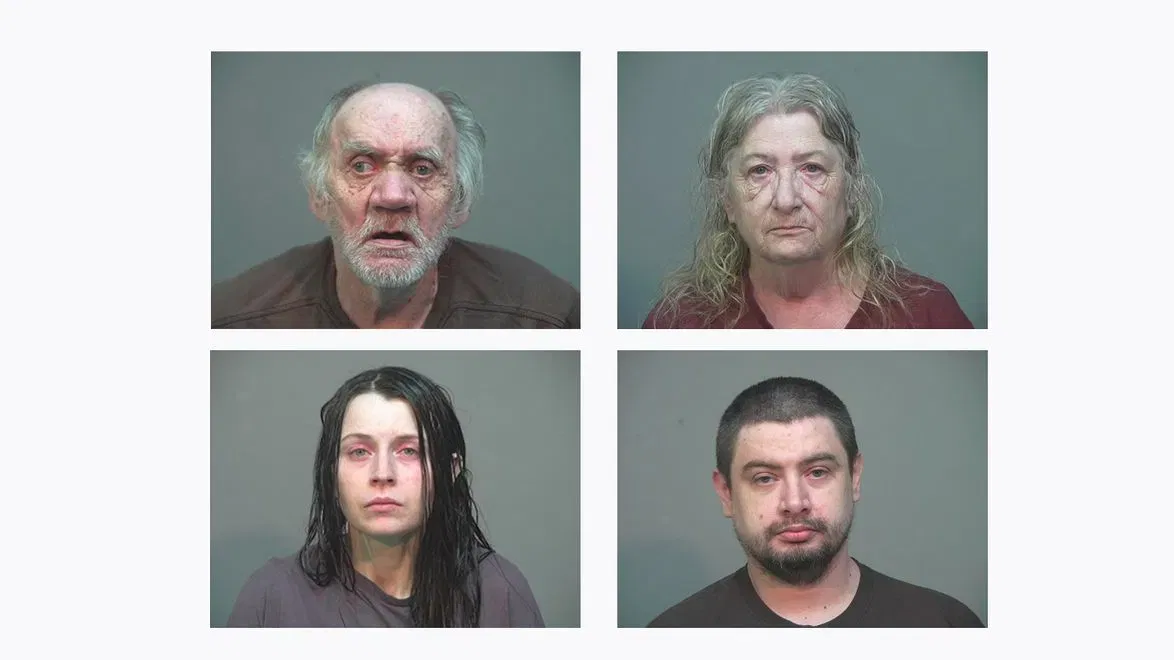
Four adults present at the home were taken into custody at the scene and booked into the county jail. According to Vinton County Prosecuting Attorney William Archer, they are:
- Gary L. Siders Sr.
- Gary L. Siders Jr.
- Christina Siders
- Elizabeth Siders
Each of the four faces multiple counts of felony child endangering. Initial charging documents reported by ABC 6 in Columbus and 10TV News indicated 16 to 17 counts per defendant, one for each child, filed at the second-degree felony level. Prosecutor Archer explained the charging decision by pointing to Ohio law: because the alleged conduct is said to have resulted in "serious physical harm" to the children, the offenses are elevated to second-degree felonies rather than the misdemeanor level that ordinarily applies to a first-time endangering allegation.
All four defendants appeared in Vinton County Court at 10:30 a.m. on Wednesday, July 1, for arraignment. A judge entered not-guilty pleas on their behalf. As of the initial court appearance, none of the four had been assigned defense counsel, and additional charges remain possible as the investigation continues, prosecutors said.
Public records reviewed by the Columbus Dispatch, a USA Today Network paper, indicate that at least one member of the Siders family has lived in Hamden since roughly June 2025, and the family had previously lived in other parts of southern Ohio.
Understanding the Charge: Second-Degree Felony Child Endangering
Ohio's child endangering statute is codified at Ohio Revised Code § 2919.22. In its most basic form, endangering a child is a first-degree misdemeanor: a caregiver knowingly creates a substantial risk to a child's health or safety by violating a duty of care, protection, or support. That baseline charge assumes no prior convictions and no proven serious injury.
The severity climbs quickly when children are actually harmed. Under § 2919.22(E), when child abuse under subsection (B)(1) "results in serious physical harm to the child involved," the offense becomes a felony of the second degree. In Ohio, a second-degree felony carries a prison term of 2 to 8 years and a fine of up to $15,000 per count, and, critically, qualifying second-degree felonies fall under Ohio's indefinite sentencing framework, which allows the Department of Rehabilitation and Correction to extend the maximum term beyond the announced sentence when justified. When a case involves 16 alleged victims and multiple charged adults, the aggregate exposure across counts is significant.
Ohio courts have long held, going back to State v. Kamel, 12 Ohio St.3d 306 (1984), that endangering does not require proof of a specific abusive act. As the court put it in that case, "an inexcusable failure to act in discharge of one's duty to protect a child where such failure to act results in a substantial risk to the child's health or safety is an offense under R.C. 2919.22(A)." In practical terms, prosecutors do not have to prove that any single caregiver struck or actively harmed a child; sustained conditions that create a substantial, ongoing risk can support the charge.
The Agencies Involved
Multiple state and local agencies are working the case in parallel:
- Ohio Bureau of Criminal Investigation (BCI). The investigative arm of the Ohio Attorney General's Office, BCI executed the search warrant with the sheriff's office and is leading the criminal investigation. BCI processes physical evidence, conducts forensic interviews, and coordinates with local prosecutors.
- Vinton County Sheriff's Office. Sheriff Ryan Cain's office made the arrests on the scene and continues to secure the residence as an active crime scene.
- Vinton County Prosecutor's Office. Prosecuting Attorney William Archer filed the initial charges and will lead the case through arraignment and beyond.
- Ohio Department of Children and Youth. Director Kara Wente is coordinating with Vinton County Children's Services on placement and ongoing medical, developmental, and trauma-informed care for the 16 children.
- Vinton County Children's Services. The local public children services agency is responsible for immediate custody, medical follow-up, sibling-connection planning, and long-term case planning for each child.
Governor Mike DeWine issued a statement through his office on Tuesday evening, saying he had spoken directly with Sheriff Cain and offered any state support that might help. "It is heartbreaking to learn the conditions that these children were living in, and to learn of their medical conditions," DeWine said. "Attorney General Wilson is an experienced prosecutor and he has told me he has never seen anything like what he saw today." The governor and First Lady Fran DeWine thanked child services workers, law enforcement officers, and medical personnel assisting the children.
A Small Village in Shock
Hamden is a village of roughly 200 residents in a county with fewer than 13,000 people, the kind of community where neighbors typically know one another and see one another's children at school, at the store, and at church. Multiple neighbors interviewed by local media said they had no idea 16 children were living inside the Ohmer Street home.
Mark Ousley, 57, who lives one street up from the house, told USA Today the allegations were "very disturbing" and said he was "surprised something like that could happen right beside me." Petey Angels, 64, said he had "never seen children anywhere near the home" and would not have guessed there were kids living inside at all. Another resident, Daniel Harmon, told ABC 6, "I mean, I was born and raised in Columbus, and this here down here is very sad and shocking because you wouldn't expect to hear it in a village of 200."
Sabrina Hill, a neighbor who spoke to local reporters, said she had heard reports of numerous animals inside the residence and voiced a question that has echoed through many similar cases: "Did they know the kids were there? I mean, that's just where it kind of bothers me. If they knew the kids were there, they should have been removed, I think." Prosecutors have not yet publicly detailed the tip, complaint, or investigative path that led to the search warrant, saying only that the case had been developing "for some time."
The Systemic Context: Why Cases Like This Keep Surfacing
The Hamden case is horrifying on its own terms, but it does not sit in isolation. Federal and state data have documented for years that severe, chronic neglect, the type of prolonged deprivation implicated when children cannot speak or give their names to responders, is the most common form of substantiated child maltreatment in the United States.
According to the U.S. Department of Health and Human Services' most recent Child Maltreatment report, based on the National Child Abuse and Neglect Data System (NCANDS), roughly three-quarters of children found to be victims of maltreatment each year in the United States are victims of neglect. Neglect is not merely the absence of care in the moment; it is often chronic, compounding, and hidden inside the home, precisely the pattern investigators appear to be describing in Vinton County.
In Ohio specifically, the state's Public Children Services Association and the Ohio Department of Children and Youth have flagged that rural counties like Vinton face persistent structural challenges in child welfare: smaller caseworker workforces, longer travel distances between families, limited access to pediatric specialty medical care, and fewer school-based mandated reporters when children are not enrolled in public schools. None of that excuses the alleged conduct of any caregiver, and none of it explains everything about this specific case, but it helps illustrate why children in isolated rural homes can go unseen for years and why community awareness matters so much.
Two structural risk factors show up repeatedly in cases where large numbers of children are found in severely dangerous conditions: social isolation and invisibility to institutional systems, including schools, pediatricians, licensed childcare, faith communities. When a household is disconnected from those systems, the children within it lose the everyday adults who would ordinarily notice hunger, injury, developmental delay, or fear on their behalf. Neighbors, delivery drivers, utility workers, and extended family are then often the last line of protection.
What Happens to the Children Now
Immediate priorities for the 16 children fall into three overlapping tracks:
- Medical stabilization. Two children remain at Level 1 trauma centers, and seven were being treated at Columbus-area hospitals. Serious, chronic neglect frequently produces medical needs that go well beyond acute injury, including malnutrition, untreated infections, dental disease, delayed growth, and unmanaged chronic conditions, and hospital teams typically coordinate with child abuse pediatricians and forensic medical specialists to document findings.
- Placement and sibling continuity. Vinton County Children's Services is responsible for identifying safe placements for each child. When sibling groups are large (16 is exceptionally large), it is often impossible to keep every sibling under one roof. Best-practice child welfare guidance calls for maintaining sibling contact whenever safe, minimizing placement moves, and prioritizing kin caregivers who can pass required background checks and home studies.
- Trauma-informed, developmentally appropriate care. Children who have experienced prolonged neglect frequently need trauma-informed therapy, developmental assessment, educational catch-up support, and consistent, calm, predictable adults. Recovery is possible, but it is neither fast nor linear, and the involved children may need long-term wraparound support that extends well beyond the criminal case.
For all four defendants, the next legal milestones will be preliminary hearings, grand jury proceedings, bond hearings, and, if the prosecutor is granted more time, the possible filing of additional charges as forensic evidence, medical records, and interviews with the children (as appropriate to their ages and capacity) develop.
What This Means for Foster and Kinship Families
Cases in which 16 siblings are removed simultaneously place enormous pressure on the local foster and kinship care system. Vinton County is small; its licensed foster homes and available kinship placements are correspondingly limited. In similar mass-removal cases in other states, agencies have turned to neighboring counties, sibling-group specialized foster homes, and emergency kinship placements to keep children safe while long-term planning unfolds.
Foster and kinship families across Ohio, and in surrounding states like Maryland, Kentucky, West Virginia, and Pennsylvania, will feel this case even if they never meet the children involved. Every high-profile removal changes public awareness of foster care, sometimes prompting a wave of inquiry from potential foster and kinship caregivers. If you have ever wondered whether you could welcome a child in crisis into your home, even for a short bridge placement, moments like this one are when that consideration matters most.
How Community Members Can Respond Safely and Constructively
It is understandable to feel angry, heartbroken, or helpless reading a story like this. There are constructive ways to channel that response, and ways that unintentionally cause more harm to the specific children involved.
- Do not seek out or share identifying information about the children. Ohio law and standard child welfare practice protect the identities of child abuse and neglect victims for a reason. Sharing names, photos, or precise addresses can compound trauma and complicate placement.
- Support the professionals doing the work. Donate to reputable foster and kinship-support organizations, court-appointed special advocate (CASA) programs, and children's advocacy centers serving southeastern Ohio and your own community.
- Learn the warning signs of severe neglect. Chronic hunger, poor hygiene, untreated medical needs, missing developmental milestones, extreme social withdrawal, and children rarely seen outside the home are all recognized indicators. Awareness is not surveillance; it is the ordinary vigilance that protects children.
- Report reasonable concerns. You do not need proof to report. You need reasonable concern.
- Consider becoming a foster or kinship caregiver, a mentor, or a trained volunteer. Ongoing, everyday capacity is what allows communities to respond to crises like this one when they surface.
Where The Blue Ribbon Project Stands
The Blue Ribbon Project is a nonprofit dedicated to preventing child abuse and neglect while supporting children, youth, and families impacted by abuse and the foster care system. We do not have direct involvement in the Ohio investigation, and we defer entirely to Ohio authorities on the facts and outcomes of the criminal case. But cases like this one are exactly why our programs exist, from Backpacks of Love, which restores dignity to children entering foster care, to Mirah's Closet, Foster Friends, A Hand to Hold, and Speak Up…Speak Out, which trains community members to recognize warning signs and take action.
Prevention is more than a slogan. It is the quiet, daily work of ensuring that no child lives in silence, that neighbors know how to report concerns, that foster and kinship families have what they need, and that survivors are believed and supported for as long as it takes.
Sources and Resources
- Associated Press - Children found in 'deplorable' Ohio home were part of same family (July 1, 2026)
- USA Today - 16 children rescued from 'deplorable' Ohio home, 4 adults arrested (July 1, 2026)
- The Washington Post - Adults arrested after 16 children found in 'deplorable' conditions in southern Ohio home
- ABC 6 On Your Side (WSYX) - 16 children rescued from 'horrific' conditions in Ohio home
- Ohio Revised Code § 2919.22 - Endangering Children
- Office of the Ohio Public Defender - Endangering Children casebook
- U.S. Department of Health and Human Services - Child Maltreatment reports (NCANDS)
- Public Children Services Association of Ohio - Vinton County Children Services
- Ohio Children's Trust Fund - Child abuse and neglect statistics
- Child Welfare Information Gateway - Recognizing and reporting child abuse and neglect